
Providers don't answer recruiting outreach because it rarely reaches a provider. It reaches a practice manager at a front desk who is also checking in patients, and it asks for six things at once: a signed agreement, a credentialing application, a W-9, a roster, a malpractice certificate and a call. Then it goes quiet, or it sends the same reminder about all six. In our experience, most network recruiting fails in the follow-up, not the pitch. Change who you reach, what you ask for and how you remind, and the same offer gets answered.
That is a claim about process, not about rates. Rates matter, and we will get to when to talk about them. But on builds we've run, a surprising share of the providers marked "not interested" were never actually asked by anyone who could say yes.
Who reads it, and what they are weighing
Picture the desk. A phone line with two calls on hold, a patient at the window, a fax tray, a stack of prior authorizations. The practice manager or office manager decides what reaches the physician, and your email is competing with everything that keeps the practice paid this week. Nobody is being difficult.
When they do read it, they are weighing four things, roughly in this order.
Rates. Is this worth the paperwork? This is the one recruiters want to avoid, and it's the one regulators keep naming. In its October 2025 review of behavioral health networks, HHS-OIG reported that providers "cited administrative burden and low payment rates." GAO's 2022 report on mental health access found that 19 of 29 stakeholder organizations it spoke with cited low reimbursement (GAO-22-104597).
Credentialing burden. How many forms, how many weeks, and will they be chasing you for status? A practice that has been through a slow credentialing process with another payer carries that memory into your email. If you can say honestly what your process takes, say it. Our piece on how long credentialing takes covers the state deadlines worth knowing.
Administrative load after joining. Directory verification calls, roster updates, prior authorization rules, one more portal login. The practice manager is the person who will do all of it.
Panel capacity. Can they take more patients at all? A practice that is full has no reason to join anything. Regulators treat this as an access fact, too: under 42 CFR 438.68(c)(1), states setting Medicaid standards must consider the "numbers of network providers who are not accepting new Medicaid patients." Ask about capacity early. A contract with a closed panel fills a row on your file and nothing else.
Notice that three of the four are about work, not money. That's the opening.
Confirm the contact, then ask for one thing
The first touch should ask for a name. Not a signature, not a packet review, not a meeting. Call the front desk and ask who handles payer contracts and how they prefer to receive them. Some practices route contracting to a billing company, some to a group administrator two states away, some to the physician's spouse. You cannot know until you ask, and every email sent to info@ before you know is a wasted touch.
Then ask for one thing at a time.
A packet that asks for everything on day one gives the reader no obvious first step, so they set it aside for later, and later doesn't come. A sequence works better, and in our experience it runs in this order: a yes to receive the agreement; the signed agreement or, for a Medicare Advantage application, a letter of intent; the credentialing application or access to an existing credentialing profile; then the supporting documents.
That letter of intent matters for new markets. Under 422.116(d)(7), an MA applicant can use letters of intent signed by both the plan and the provider in place of signed contracts during application review, and must have signed contracts by the start of the contract year. That makes the LOI a smaller, earlier ask, and a good second touch. The timing is covered in the service area expansion timeline.
Before you ask for a credentialing application, check whether the provider already maintains a CAQH ProView profile (the service now carries the DataSpring name). Per CAQH's provider user guide, profiles must be re-attested every 120 days and expire without it. A current profile turns a 20-page application into a permission request.
Make the packet a portal, not a fax
If the practice manager has to print, sign, scan and fax, you have added a step for every item you asked for. A provider portal changes the question from "did you get my email?" to "here is your link, and here is what's left." They see what is done. You see what is missing. Nobody retypes a license number from a blurry scan.
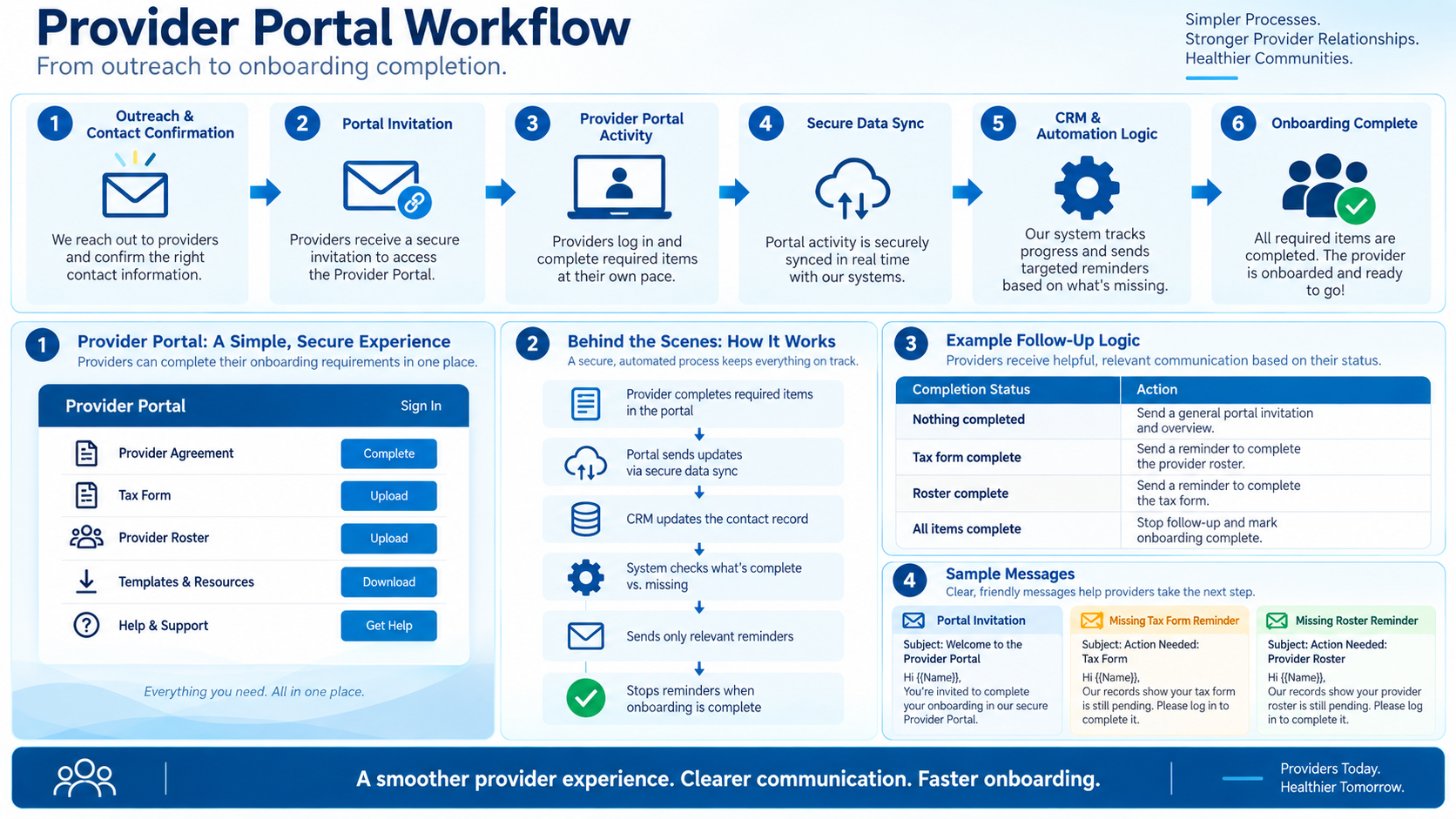
What goes in the portal is its own question; our checklist of what to collect when onboarding a provider covers it. If you want one built to your process, Blueprint builds custom provider portals as a paid service, from $15,000, and ten live layouts are at /provider-portal/templates.
Remind about what's missing, then stop
A reminder that lists all six items again tells the reader you are not tracking what they already sent. That is the fastest way we know to lose a practice manager's goodwill.
The rules are short. Each reminder names only the items still outstanding. When an item arrives, it drops off every future message. When everything is in, reminders stop and a thank-you goes out. When someone says no, log the reason and stop. And every touch has a named owner, so a reminder never goes out from a person who has since left the team.
Here is a cadence we use as a working template. The days are starting points, not benchmarks, and you should tune them to the market and to your filing deadline.
| Touch | When | Channel | The one ask | Branch |
|---|---|---|---|---|
| 1 | Day 0 | Phone call to the front desk | Name and email of whoever handles payer contracts | Move to touch 2 once you have a name |
| 2 | Day 1 to 2 | Email to that person | A yes to receive the agreement, or a 15-minute call | If they say no or their panel is closed, log the reason and stop |
| 3 | Day 3 to 5 | Portal link | Signed agreement or letter of intent | Once signed, the next ask becomes the credentialing application |
| 4 | Day 10 | Email naming the missing item | Only the item still outstanding | Stop when it arrives |
| 5 | Day 17 | Phone call to the practice manager | "What's in the way?" | If the answer is rates, escalate; if it's capacity, log it |
| 6 | Day 28 | Short closing email | Nothing; leave the door open | Mark paused with a reason and set a recheck date |
Touch 5 is a phone call on purpose. By then the practice manager has seen three messages, and a real question from a real person gets an answer a fourth email won't.
Log every touch on the provider record
Every call, email, portal visit and reason code belongs on the provider's record, not in a recruiter's inbox. That's how the handoff survives a vacation, and it's how you see patterns: which practices stall at the agreement, which at credentialing, which went quiet after a rate question.
It also keeps you honest about exceptions. CMS does not accept "inability to contract" as a rationale for a network adequacy exception; the December 2024 guidance points to the non-interference clause. So a log of twelve unanswered calls buys you nothing with CMS. What it does is tell you, early, which gaps need a different approach. More in our exception request guide.
When to move to a rate conversation
Don't lead with rates, and don't discount before anyone asks. Escalate to a rate conversation when one of three things is true: the practice manager names rates as the obstacle; the provider closes a gap nobody else in the market can close; or the practice is engaged but stalled at signature after touch 5. When you escalate, move it to someone with authority to change the offer, and bring the gap math: which counties, how many uncovered members, and what the alternative costs you.
In Medicaid, this has a regulatory edge now. Under the 2024 managed care rule, for rating periods beginning on or after July 9, 2026, state exceptions to network adequacy standards must include "consideration of the payment rates offered" by the plan (438.68(d)). The rate you offered a provider who said no is part of the record.
Call the provider who closes the most gaps first
Everything above makes each outreach better. None of it tells you who to call. That decision belongs to the adequacy gap list, not to whoever is easiest to reach.
Recruit by coverage added. Here is a fictional Rural county failing Psychiatry, where the base standard is 75 minutes and 60 miles:
| Candidate | Where | Uncovered members closed (sample) | Call order |
|---|---|---|---|
| Psychiatrist, solo practice | Town across the county line, 40 miles east | 1,300 of 1,900 | First |
| Psychiatrist, hospital-employed | County seat, where most members are already in range | 90 | Third |
| Group of three, eager to join | Neighboring county that already passes | 0 | Not for this county |
The eager group is the one your team will want to call first, because they will say yes. They add nothing to this filing. The solo psychiatrist across the county line is harder to reach and matters most, and CMS guidance says access is measured without regard to county or state boundaries, so that practice counts.
That ranking is what Blueprint's recruit list does: it orders candidates by the uncovered members each would close, on the same record where the outreach, the missing items and the follow-up live. Distance is straight-line today, so a pass shows as "unconfirmed" until it is measured on roads. You can run the what-if on sample data at /network-map.
The pitch gets a practice manager to open the email. The follow-up gets the agreement signed. Put your best people on the second part.
Common questions
- How do you recruit providers into a health plan network?
- Start from the adequacy gap list and call the providers who would close the most uncovered members first. Confirm the right contact at the practice, usually the practice manager, then ask for one thing at a time through a portal, remind only about what is missing, and log every touch on the provider record.
- Why won't doctors join my network?
- Practices weigh rates, credentialing burden, the administrative work of being in network, and whether they have panel capacity. HHS-OIG reported in 2025 that behavioral health providers cited administrative burden and low payment rates. Often, though, the outreach never reached the person who decides.
- How many times should you follow up with a provider during recruitment?
- There is no regulatory number. As a working template we use about six touches over four weeks, mixing phone and email, with each reminder naming only what is still missing. After that, pause with a logged reason and set a recheck date rather than repeating the same message.
- Who should provider contracting outreach go to?
- Usually the practice manager or office manager, who decides what reaches the physician and does the paperwork. Some practices route contracting to a billing company or group administrator, so the first touch should confirm the right name before asking for anything.
- Is inability to contract a valid reason for a CMS network adequacy exception?
- No. CMS's December 2024 Medicare Advantage network adequacy guidance says inability to contract is not a valid exception rationale, citing the non-interference clause. Outreach logs help you manage recruiting, but they will not support an exception on their own.
Sources
- HHS-OIG, OEI-02-23-00540, limited behavioral health networks and inactive providers (Oct. 2025)
- GAO-22-104597, Mental Health Care: Access Challenges for Covered Consumers (Mar. 2022)
- 42 CFR 438.68, Network adequacy standards (eCFR)
- 42 CFR 422.116, Network adequacy, including letters of intent at (d)(7) (eCFR)
- CMS MA and Section 1876 Cost Plan Network Adequacy Guidance (Dec. 2024)
- CAQH Provider Data Portal Provider User Guide v43
The Blueprint team
Provider network build practice
Written by the people behind Blueprint, who between them have spent 30 years building provider networks for health plans: recruiting and contracting providers, chasing credentialing, and filing adequacy. Blueprint is new. The experience behind it isn't.