Custom provider portals · Builds from $15,000
Your providers get a portal. Your logo on it.
Two jobs, one place: bringing new providers into the network, and keeping the information on the ones already in it current. Providers maintain their own details instead of your team chasing them. Built by our integration team as part of a network build, scoped to what you need.
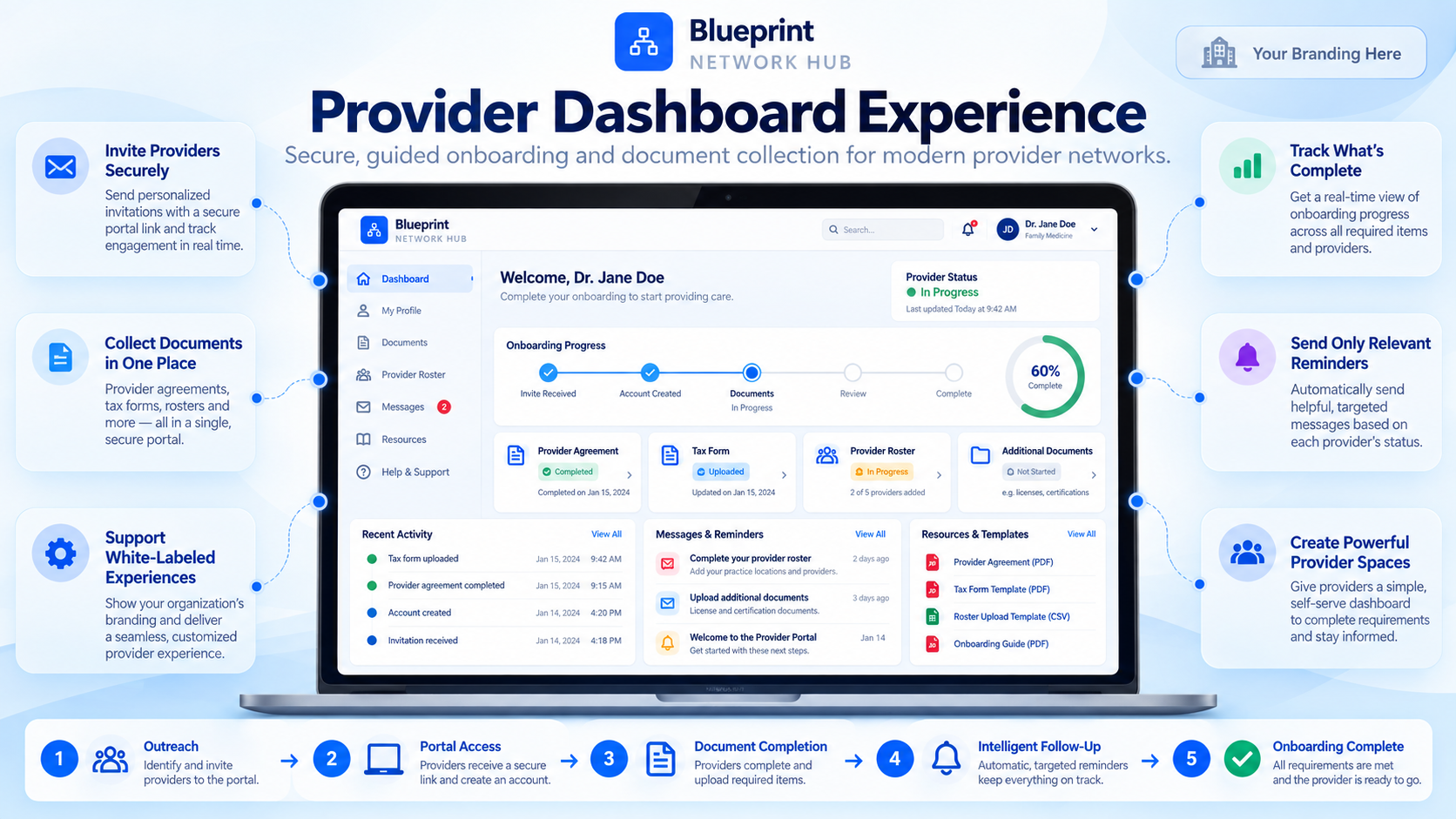
What a provider sees when they sign in. Built by our team in prior engagements — Blueprint is new, the experience behind it isn’t. Tap the image to view it full size.
Your network data is only as current as your last phone call.
A provider moves offices. Closes their panel. Adds a nurse practitioner, drops a location, changes the specialty they actually practise. None of that arrives on its own. Someone on your team finds out months later, usually because something went wrong downstream.
Meanwhile the providers you’re trying to bring in are waiting on an email thread to tell them what’s left. The slower and more opaque that is, the more of them quietly stall.
Both problems have the same cause: there’s no shared place where a provider can see and correct their own record.

This is the other end of every request you send. One person, a stack of folders, and your form somewhere in it. Anything that makes this desk’s job easier gets done sooner.
One place, two points of view.
The provider sees and maintains their own record. Your team sees the whole network at once, and every correction a provider makes lands straight in the pipeline.
The provider sees
- Their locations, panel status and specialties
- What's outstanding to join, and only that
- Practitioners to add or remove from a roster
- Templates, so nobody guesses the format
- Progress, so they know how close they are
Your team sees
- Every provider's status on one screen
- Which records haven't been confirmed recently
- Who's stalled joining, and on which item
- Changes attached to the right record, with a date
- Completion feeding the contracting pipeline
Onboarding happens once. The data going stale happens forever.
A provider who joined in March has moved, hired two people and closed their panel by October. Nothing about that is unusual, and nothing about it reaches you unless somebody asks.
So the portal stays open after a provider is contracted. They keep their own record current, and you can ask the whole network to confirm their details on whatever cadence you need — quarterly, before a filing, ahead of a directory refresh.
A provider correcting their own address is faster and more accurate than your team calling to ask for it. It’s also the only version that scales past a few hundred providers.
The part that matters
Reminders that know what’s already done.
A portal that only stores documents still leaves your team doing the chasing. The follow-up rules are the difference, and they’re written around your requirements.
- Nothing startedInvitation and a short overview of what's needed.
- Tax form inOne reminder, about the roster only.
- Roster inOne reminder, about the tax form only.
- Everything inReminders stop. Marked complete in your pipeline.
Outreach through to onboarded.
The whole flow, including what happens behind it.
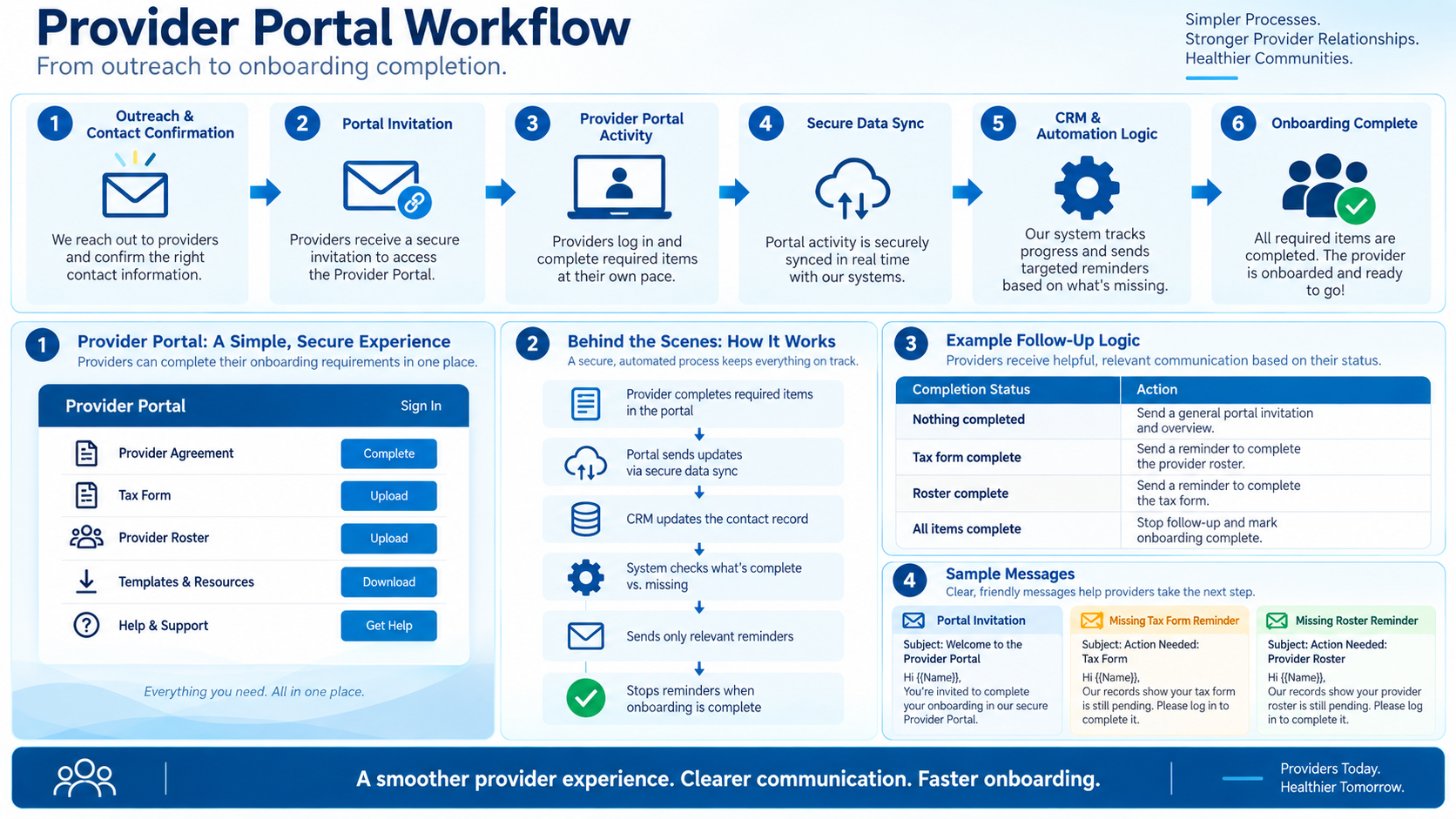
Tap the image to view it full size.
This isn’t a switch we flip.
Builds start at $15,000.
The screens are the easy part. What you’re paying for is underneath them: automation that knows what every provider has and hasn’t supplied, follow-up that fires on that status and stops the moment someone finishes, notifications routed to your team when a provider stalls, and integrations pushing each change back into your pipeline and whatever systems sit downstream of it.
That logic is built around your documents, your rules and your systems, which is why it’s an engagement rather than a setting. It carries your branding, not ours. Where it lands above $15,000 depends on how many document types you collect, how deep the integrations run, and how unusual your requirements are — and we’ll give you that number after one call, not after a paid discovery phase.
The screens above are illustrative: they show the kind of thing we build, not a running deployment you can sign up for today.
If that sounds like more commitment than you want, start with the CRM and add this later. Plenty of teams should.
Tell us how you collect provider information today.
The forms, the phone calls, the spreadsheet somebody keeps. We’ll walk through what a portal would take, what it would cost, and whether it’s worth it at your network’s size.
Schedule a demo